This is the first proper Penfjell research blog post. It is not written as a Wall Street quant paper, and it should not be read as one. It is a retail and independent trader research note about how a real MT5 strategy evolved, what went wrong, and what risk controls had to be added before the system deserved to be watched in live conditions.
Penfjell S1.1 began with a smaller idea: MPTS, originally meaning MACD Positive Transition Scalping. It looked for positive MACD transition behaviour, joined the move, and tried to take modest profits. The name no longer tells the whole truth. The strategy is no longer really scalping, and it is no longer only about positive transition, but that first setup gave the system its starting point.
The first lesson was uncomfortable. Positive returns were possible, but hard to maintain. Long gains could be offset by sharp losses. The question was not only whether a signal could win. It was whether the account could survive the environments where that signal was weak.
That led to MACD plus RSI mean reversion, then to a broader mix of symbols whose regimes behaved differently. FX, metals, energy, and indices each brought different behaviour. Some helped. Some disappointed. Some became concentration risks. Penfjell S1.1 was born when the strategy moved from one signal into a diversified set of behaviours, symbols, and risk controls.
What S1.1 Is Trying To Do
Penfjell S1.1 is best understood as a multi-symbol MT5 strategy with two complementary model families:
- MPTS: the original MACD transition idea, now developed into a broader trend and persistence engine.
- MRMR: a MACD plus RSI mean-reversion engine designed to behave differently from the trend component.
The goal is not to make every market environment profitable. That is not realistic. The goal is to reduce dependence on one behaviour, one market, one timeframe, or one volatility regime.
From Signal To Risk Framework
The core of Penfjell S1.1 is not only the alpha model. The risk framework is equally important. The framework currently has seven layers.
| Layer | Control | Purpose |
|---|---|---|
| 1 | Trade-level risk | Position sizing, stop geometry, take-profit logic, lot limits, and execution validation. |
| 2 | Symbol-level risk | Monitor each symbol as its own contributor to portfolio behaviour. |
| 3 | Adaptive sizing | Allocate more to symbols with persistent contribution and less to symbols that deteriorate. |
| 4 | Drawdown throttling | Reduce exposure when account behaviour moves outside normal expectations. |
| 5 | Portfolio concentration control | Track whether returns are too dependent on one symbol or asset class. |
| 6 | Weekend and event exposure | Reduce unwanted gap risk around closures and known event windows. |
| 7 | Execution governance | Prefer one logical position as one aggregate order, not many small tickets. |
The execution lesson deserves emphasis. Earlier versions used multiple small tickets to represent one logical position. That created unnecessary operational risk and was not suitable for all broker or prop-firm environments. The revised principle is simple:
one logical position = one aggregate orderThat is cleaner, easier to audit, and better aligned with professional execution practice.
Candidate Testing
The strategy was tested across several risk profiles. These are not product promises, and they are not forecasts. They are historical research candidates used to compare return, drawdown, monthly tail risk, and overall quality.
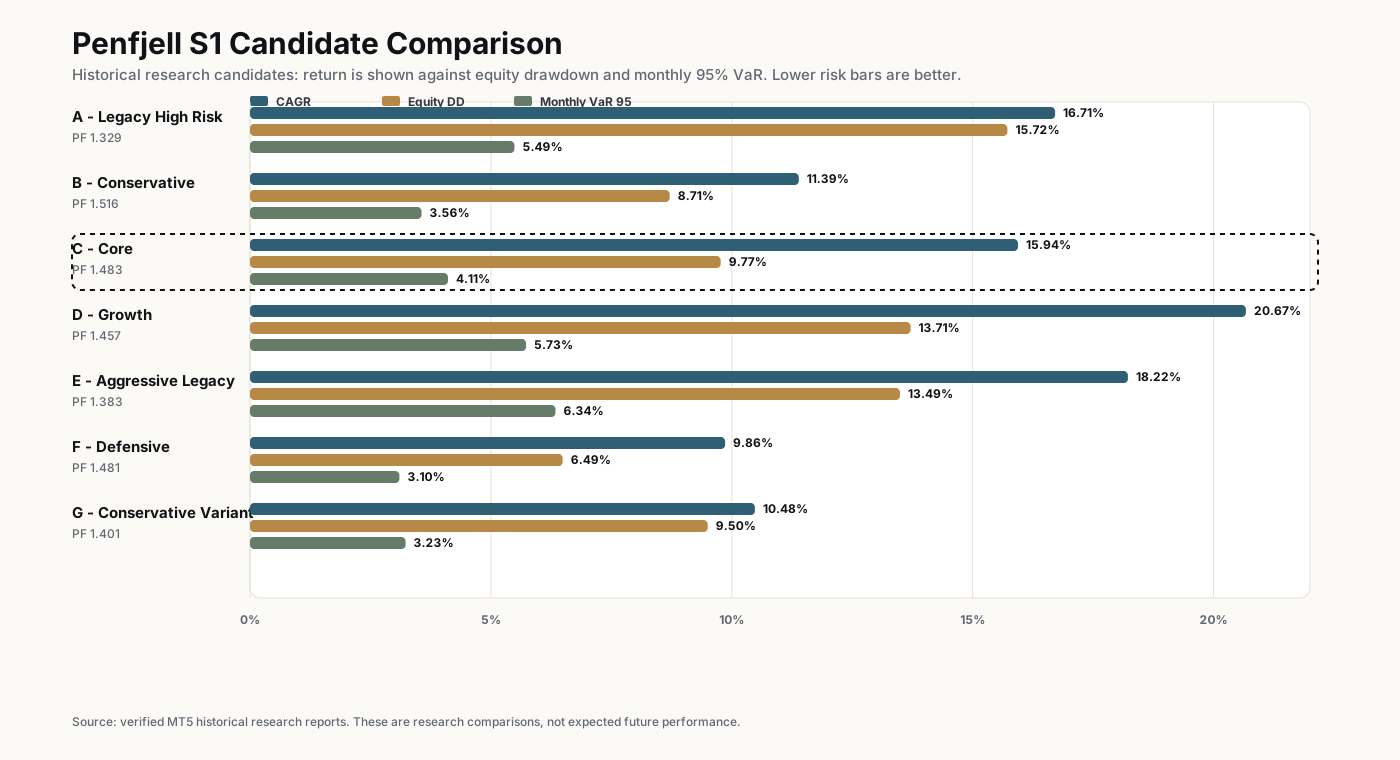
The current ranking is Core first, Growth second, and Conservative third. Growth produced the highest return but carried more drawdown and monthly tail risk. Conservative was cleaner but gave up too much return for the flagship profile.
The Current Core Profile
The verified historical report summary for that Core candidate was:
| Metric | Value |
|---|---|
| Starting balance | GBP 25,000 |
| Final balance | GBP 64,278.87 |
| Net profit | GBP 39,278.87 |
| Total return | +157.12% |
| CAGR | ~15.94% |
| Balance drawdown | -9.71% |
| Equity drawdown | -9.77% |
| Monthly VaR 95 | ~4.11% |
| Worst month | -5.21% |
| Months below -6.5% | 0 |
| MT5 Sharpe | 1.859 |
| Profit factor | 1.483 |
| Last 12m return | +20.34% |
| Last 12m VaR | ~3.89% |
This is the strongest current combination of return, drawdown control, monthly risk, recent performance, and risk-adjusted behaviour. The main caveat is concentration, especially XAUUSD contribution.
Extended Regime Testing
An extended Core-style test was also run from 2018 to 2026 using 1-minute OHLC modelling. That is not the same quality as every-tick modelling, so it is not treated as the primary deployment report. It is still useful as a regime exploration test.
The extended run grew GBP 10,000 to GBP 27,040.67, with ~12.97% CAGR, 1.52 profit factor, -9.00% equity drawdown, 3.28% monthly VaR 95, and 62 positive months out of 98. The important observation was that weaker historical regimes appeared more like stagnation or mild underperformance than uncontrolled failure. That does not remove risk, but it changes what should be monitored. The system needs live stagnation monitoring, not only drawdown monitoring.
Demo Equity Curve Risk Analysis
The strategy was deployed to a demo account in April 2025 and later stitched across a Phase 2 reset so the risk analysis could view the account as one continuous curve.
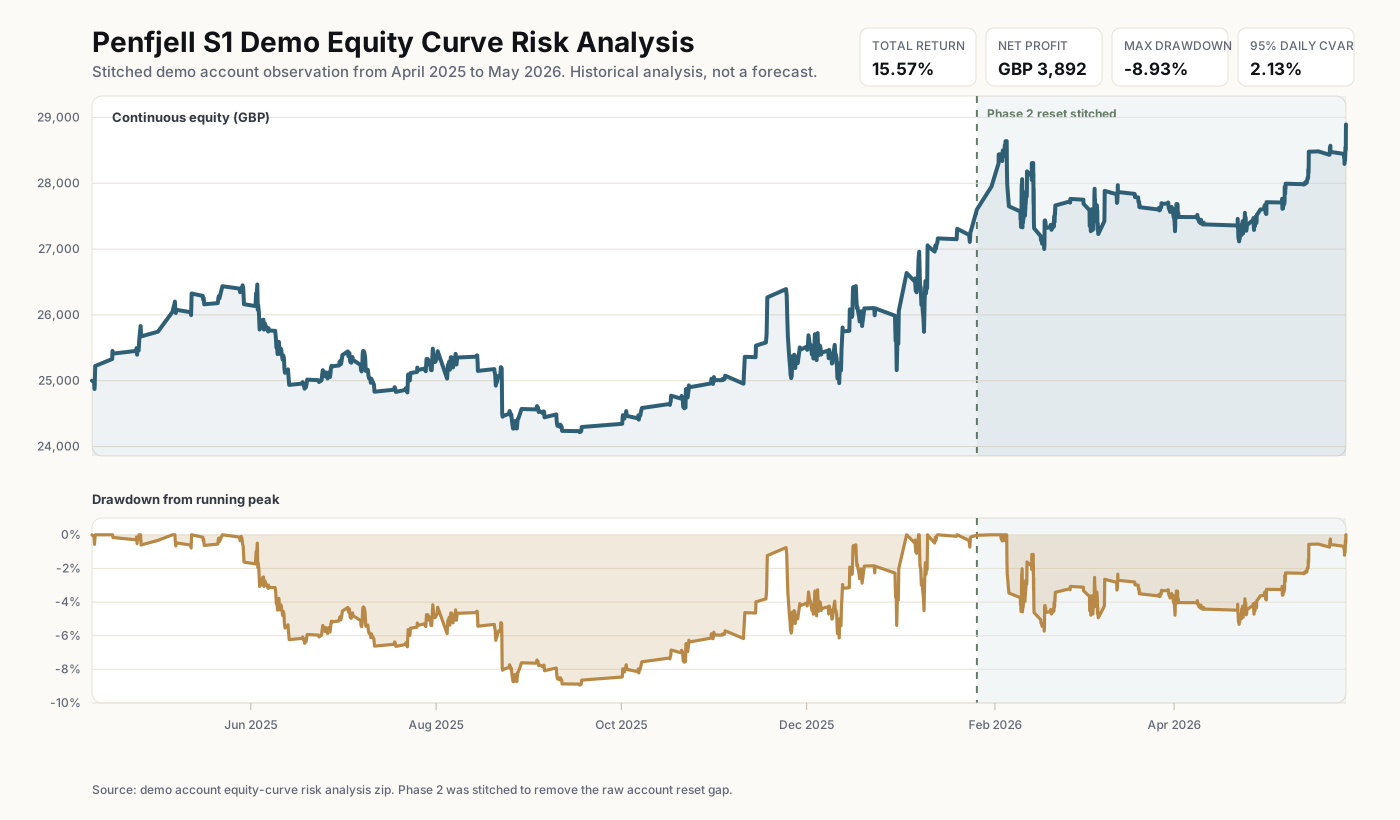
The stitched demo curve ran from 9 April 2025 to 27 May 2026, moving from GBP 25,000 to GBP 28,892.46 for +15.57%. The maximum drawdown was -8.93%, with 95% daily VaR around 1.25% and 95% daily CVaR around 2.13%.
This was not a smooth straight line. The drawdown from late May to mid-September 2025 was a real stress period. The important point is that the system recovered by early January 2026 and then moved to new highs by late May 2026.
Monthly returns also showed why the risk framework matters. April and May 2025 were positive, June 2025 was negative, and May 2026 was strong at +4.56% for the month-to-date window in the analysis. That kind of variation is exactly why monthly loss bands, drawdown bands, and rolling return bands need to exist before live capital is scaled.
Live Deployment Observation
The live account report covered 14 February 2026 to 2 June 2026, with realised exit trades from 16 February to 27 May 2026 in the workbook.
| Metric | Live account observation |
|---|---|
| Starting balance | ~GBP 7,181 |
| Ending balance/equity | GBP 8,013.16 |
| Report net profit | GBP 832.15 |
| Return | +11.59% |
| Closed positions | 245 |
| Win rate | 48.16% |
| Profit factor | 2.20 |
| Max balance drawdown | 2.62% |
| Largest profit trade | GBP 69.47 |
| Largest loss trade | -GBP 95.72 |
| Average profit trade | GBP 12.69 |
| Average loss trade | -GBP 5.53 |
The live sample is promising, but it is still short. It should be treated as early evidence, not proof.
The realised exit-deal contribution in the workbook showed the same concentration lesson again:
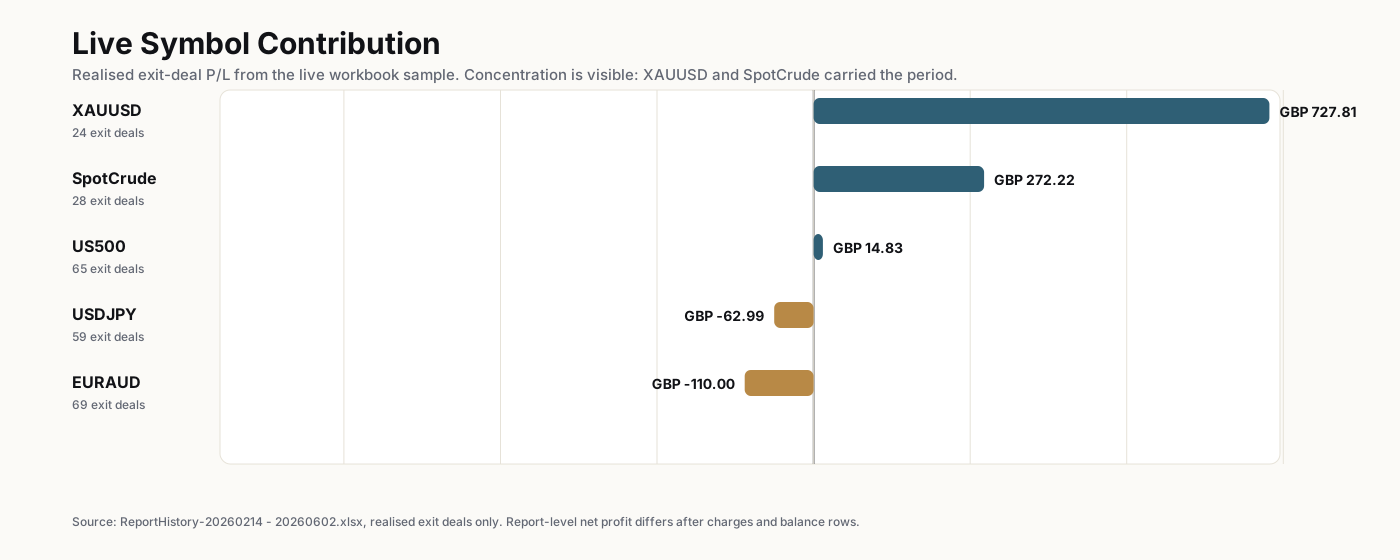
This is both encouraging and uncomfortable. XAUUSD and SpotCrude did the heavy lifting. EURAUD and USDJPY were negative. US500 was active but barely contributed. That is exactly why the next reporting generation needs symbol-state logs, contribution monitoring, and quarantine rules.
Research Lessons So Far
The main lessons are practical.
Execution design matters. A strategy can be profitable in testing and still create avoidable operational risk if its order structure is poor.
Custom logs are not enough. Diagnostic logs are useful, but the preferred evidence hierarchy is now MT5 comprehensive report first, MT5 tester graph or account equity curve second, balance and risk logs third, and custom result diagnostics last.
Adaptive sizing must be auditable. The next generation of reporting should show base lot, final lot, symbol cumulative P/L, rolling symbol P/L, rolling symbol profit factor, account drawdown multiplier, symbol performance multiplier, floor/cap status, and quarantine status.
Symbol floors need discipline. A weak symbol can remain active only if the floor is intentionally small and justified by diversification value. A proposed rule is that a symbol with negative rolling 50-trade P/L should not be allowed to increase allocation.
Gold concentration must be monitored. XAUUSD has been a major contributor. That is positive, but it is also a dependency. Useful tests include Core with XAUUSD capped, Core without XAUUSD, Core during flat gold regimes, and rolling XAU contribution as a percentage of total P/L.
Deployment Health Bands
The current monitoring bands for S1 Core are operational thresholds, not guarantees.
| Live equity drawdown | Status | Action |
|---|---|---|
| < 7% | Green | Normal |
| 7% to 9.8% | Normal stress | Continue monitoring |
| 9.8% to 11% | Amber | Review symbol and model behaviour |
| 11% to 12% | Red | Reduce or pause scaling |
| > 12% | Critical | Suspend or pull deployment |
| > 13% intraday | Emergency | Stop new exposure |
| Monthly loss condition | Status | Action |
|---|---|---|
| Better than -4% | Green | Normal |
| -4% to -5.5% | Amber | Review |
| -5.5% to -6.5% | Red | Serious review |
| One month worse than -6.5% | Serious | Investigate immediately |
| Two months worse than -6.5% in 12 months | Critical | Pull, pause, or halve risk |
| Trade expectancy condition | Action |
|---|---|
| Profit factor below 1.25 after 100 trades | Warning |
| Profit factor below 1.15 after 150 trades | Reduce risk |
| Profit factor below 1.05 after 200 trades | Pull or suspend |
Where S1.1 Stands
Penfjell S1.1 is no longer the simple MACD Positive Transition Scalping idea it started as. It is a multi-symbol strategy with two alpha families, a layered risk framework, and early evidence from historical testing, demo equity-curve analysis, and a short live deployment window.
The current evidence supports the Core profile as the leading configuration, with Growth and Conservative variants still useful for different risk appetites. But the next step is not to declare victory. The next step is to improve live monitoring, symbol-level transparency, concentration control, and execution governance.
That is the real journey of Penfjell S1.1 so far: less about finding one perfect signal, more about building a system that can survive its own weak periods.
Nothing in this post is investment advice or a recommendation to trade any strategy, symbol, or product. Historical, demo, and early live results are not reliable indicators of future performance.